Burnout hypervigilance makes good days feel like a trap. Here is why you brace for the crash and how to let a good day be a good day.
Last updated: 15 October 2026
The day goes well. The kids are kind, the house is okay, dinner is on the table, and nobody cried in the car. And instead of enjoying it, you are standing there with your shoulders up by your ears, waiting for the other shoe to drop. 🫠
That is burnout hypervigilance, and it is not you being ungrateful or dramatic. After burnout, your body learns that calm is where the crash starts, so it scans for danger even on easy days. The American Psychological Association’s Monitor on Psychology reported in 2021 that up to 5 million US parents experience parental burnout each year, so a lot of tired mothers are bracing in kitchens right now.
I want to walk you through why your good days feel suspicious, what is actually happening in your body, and what you can do about it. I will also tell you about the moment I realised how braced I really was. It happened at a dinner table, and it was not dramatic at all.
Why do I feel nervous when everything is going well?
You feel nervous on good days because your body has learned that a good day is not safe to trust. After a long stretch of running on empty, it remembers how quickly calm turned into collapse. So it keeps watch, even when nothing is wrong.
Think of it as a smoke alarm that got turned up too high. It no longer waits for smoke. It goes off at toast. 🍞
The cruel part is that the bracing feels like being responsible. You tell yourself you are just being realistic. But realistic does not usually come with a clenched jaw and a body that cannot sit down.

What is burnout hypervigilance, and is it real?
Hypervigilance is a heightened state of awareness in which your brain keeps scanning the environment for signs of danger. That is how psychologist Susan Albers describes it in a Cleveland Clinic explainer from 2023. The same article is clear that hypervigilance is not a diagnosis. It is a symptom that shows up alongside many different conditions.
I am not telling you that you have a condition. I am telling you the pattern has a name, and the name is not “you are bad at relaxing.”
The Cleveland Clinic piece also lists what long term hypervigilance can feel like: exhaustion, trouble sleeping, poor concentration, irritability and a strong startle reflex. Does that sound like your Tuesday? Mine too. 💛
What happened at my dinner table?
I did not know how braced I was until my body moved before I did. It was an ordinary evening. Nothing dramatic, nobody fighting, food on the plates.
My boyfriend came up behind me and put his hand on my shoulder. I pulled away before I even knew I was doing it. We both froze.
Neither of us said anything for a second. He was shocked, and so was I, because I love that man and it was a kind touch. That was the moment I understood how empty I actually was, and how much of me had been on guard for months.
I had been so busy watching for the next problem that a gentle hand registered as one. If that is you too, I wrote more about what happens when you love your kids and cannot let them touch you anymore.
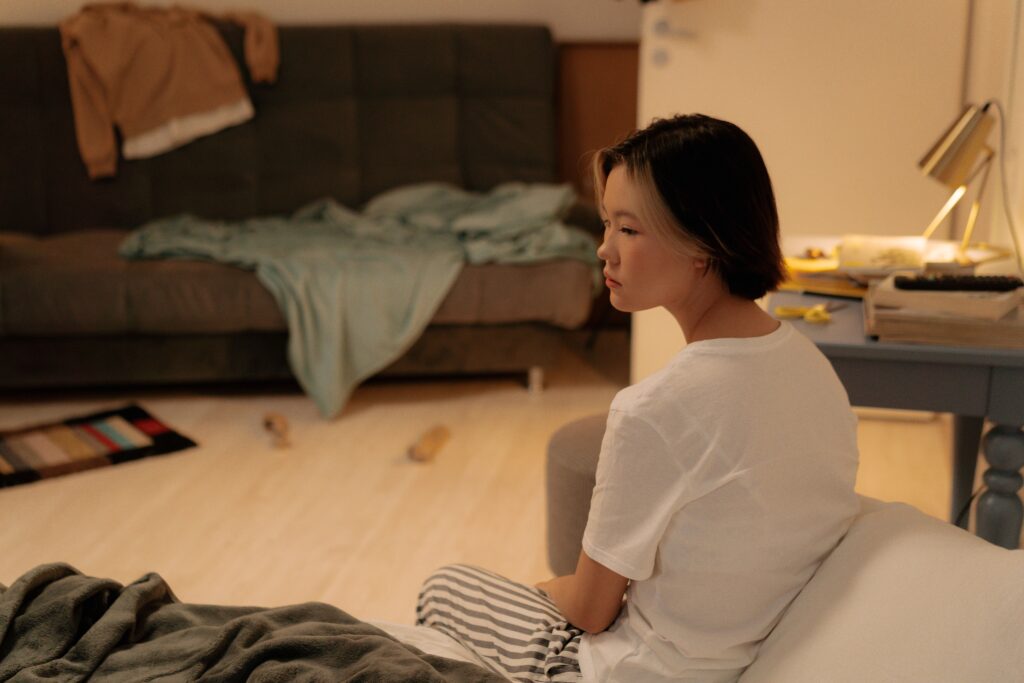
Is this the same as being afraid of happiness?
It overlaps, and researchers have studied the fear of happiness for years. Paul Gilbert and colleagues found in 2012 that fear of happiness is strongly linked to depression. Mohsen Joshanloo of Victoria University of Wellington then built a Fear of Happiness Scale and showed in 2013, in the Journal of Cross Cultural Psychology, that it held up across 14 cultures.
Their work was covered in Scientific American’s 2014 piece “Afraid of Happiness”. It describes people who believe that good fortune inevitably leads to a fall, and some who feel uneasy whenever they are not worrying.
I want to be careful here. Burnout bracing is not the same thing as a clinical fear of happiness, and I am not diagnosing anyone. But the belief that good things get taken away is the same shape, and it makes sense that a burned out brain would learn it.
How can I tell a real warning sign from bracing?
Real warning signs live in your body and your capacity, while bracing lives in your predictions. A warning sign says “I am running low right now.” Bracing says “something terrible is about to happen because today is too nice.”
Here is a rough way to sort them, with the warning signs first and the bracing second.
A real warning sign usually looks like this:
- It is about right now, in this hour.
- It feels heavy, foggy, or like a short fuse.
- The thought is “I need to stop.”
- It gets better with rest, food, quiet or help.
Bracing usually looks like this:
- It is about later, someday, or “sooner or later.”
- It feels tight, alert and jumpy.
- The thought is “this cannot last.”
- It gets better with reassurance and one slow breath.
Both are real and both deserve kindness. The trick is knowing which one is talking.
That is exactly what The Battery Check is for. It helps you find where your battery actually is today and what your own warning signs look like, so you can tell the difference between a low battery and a loud alarm. 🪷

Why does bracing leave me even more tired?
Bracing is work, and it spends the same energy you are trying to rebuild. Keeping your guard up all day costs fuel, which is why a good day can still leave you flat by 7pm.
This is also why more rest alone does not fix mom burnout. You can sleep for eight hours and still wake up braced, because your nervous system never got the message that it is allowed to stand down.
Researchers describe parental burnout as moving through stages. According to the same APA article, Moïra Mikolajczak describes overwhelming exhaustion first, then emotional distancing from your children as you try to conserve energy, then a loss of fulfilment in parenting.
The bracing is often the part that keeps the exhaustion going. That is not your fault. It is just useful to know. 🌙
What can I do on a good day when my body will not let me enjoy it?
Start small and treat the bracing as information, not as an enemy. You are not trying to force joy. You are trying to give your body one tiny piece of evidence that a good moment can be just a good moment.
Here is what has helped me.
- Name it out loud. Say “oh, I am bracing” to yourself, quietly, like greeting an annoying neighbour.
- Set a ten minute rule. Let yourself enjoy the next ten minutes, and promise your worried brain it can have the worry back afterwards.
- Do one slow thing with your hands. Wash a cup, fold one towel, hold a warm mug.
- Say one true sentence about now. For example, “Right now my daughter is laughing and nothing is on fire.”
- Let the good be boring. Not every good day needs to be savoured, photographed or earned.
Notice there is no fixing in that list. If your head also feels loud in the evenings, why you cannot relax even when the kids are finally in bed goes deeper on that exact feeling.

What if the crash really does come?
Sometimes the hard day does come, and that does not mean bracing was right. A bad afternoon is not proof that your good morning was a trap. It is just a Tuesday with kids in it. 😅
Your body keeps score of the hits and forgets the misses. That is how a smoke alarm learns that toast is dangerous.
What helps most is having a plan for the crash that is smaller than the dread. Know who you would text, what you would cancel, and which dinner is the easy dinner. When the soft landing is ready, the good day gets a little less scary.
And if the crashes keep coming no matter what you do, read about what mom burnout recovery actually looks like and talk to a doctor or therapist you trust. You deserve more support than a blog post. 💛
FAQ
Why do I feel anxious when things are going well?
After burnout, your nervous system links calm with the crash that followed it. So it stays on watch, even on easy days. This is a protective pattern, not a character flaw, and it usually softens as your capacity rebuilds.
Is waiting for the other shoe to drop a sign of burnout?
It can be. Hypervigilance, a state of heightened alertness, often shows up with exhaustion, irritability and poor sleep, according to the Cleveland Clinic. It is a symptom, not a diagnosis, so if it is intense or constant, please talk to a professional.
How do I stop bracing for the crash?
You do not stop it by force. You give your body small, repeated proof that calm can be safe, such as a ten minute pause or naming the bracing out loud. Rebuilding your energy matters as much as managing your thoughts.
Is fear of happiness a real thing?
Yes. Researchers including Paul Gilbert (2012) and Mohsen Joshanloo (2013) have studied it, and Joshanloo’s scale held up across 14 cultures. It is not the same as burnout, but both involve expecting good things to be taken away.
Can I enjoy good days again after burnout?
Most moms can, though it tends to come in pieces rather than all at once. As your battery refills and you collect more good days that stay good, the alarm gets quieter. Be patient with the pace.
So what now?
A good day is not a trap, even if your body has learned to treat it like one. Your bracing makes sense, it has a name, and it can soften with time, small proof and a lot less pressure on yourself.
If you want a gentle place to start, try The Battery Check and see where your battery actually is today. Then let the next good hour be just an hour. 🪷
And if you notice your shoulders have crept up to your ears while reading this, drop them. Nothing is about to happen. Go drink your coffee while it is still warm. ☕

Wendy Venema
A late-realized AuDHD mom in a blended family of seven. I write the posts I needed when I was crying on the bathroom floor.
Read my story