
That get off me feeling is not you being cold.
You know the one. It is the end of a long day, your kid climbs onto your lap, and every cell in your body screams please, no. Not because you do not love them. You love them so much it aches. Your skin just cannot take one more thing landing on it.
For years we called this touched out and treated it like a mood. A bad day. A bit of grumpiness. But touched out is not just a mood. It sits right next to anxiety in your nervous system, and almost nobody told you that.
If you have ever felt your skin crawl when someone reaches for you, if the constant contact of motherhood leaves you wanting to climb out of your own body by evening, this post is for you. I want to explain what touched out actually is underneath the surface. Why it is a physical, nervous system event and not a character flaw. And what helps when your body slams the gate shut without asking your permission first.
You are not broken and you are not cold. You are overloaded. Let us talk about it. 🪷
Touched Out Is A Full Nervous System, Not A Bad Attitude
Let us define it properly, because the casual version does it no justice.
Touched out is what happens when your nervous system hits its limit on sensory input. All day, your body has been processing contact, noise, demand, and motion, and at a certain point the system simply maxes out and starts refusing new input.
That refusal feels like a flinch. A recoil. A desperate internal need for everyone to stop breathing on you for one minute.
It is not a decision. It is not a mood you could just choose your way out of. It is your body protecting itself the only way it knows how, by closing the door on more stimulation.
You are not being difficult. Your tank is full and there is genuinely nowhere left to put one more touch.
This is why willpower does not fix it. You cannot decide to want to be touched when your system is in overload, any more than you can decide to be hungry right after a huge meal. If you have never read the full explanation of this feeling, start with what touched out actually means and why it is not your fault.
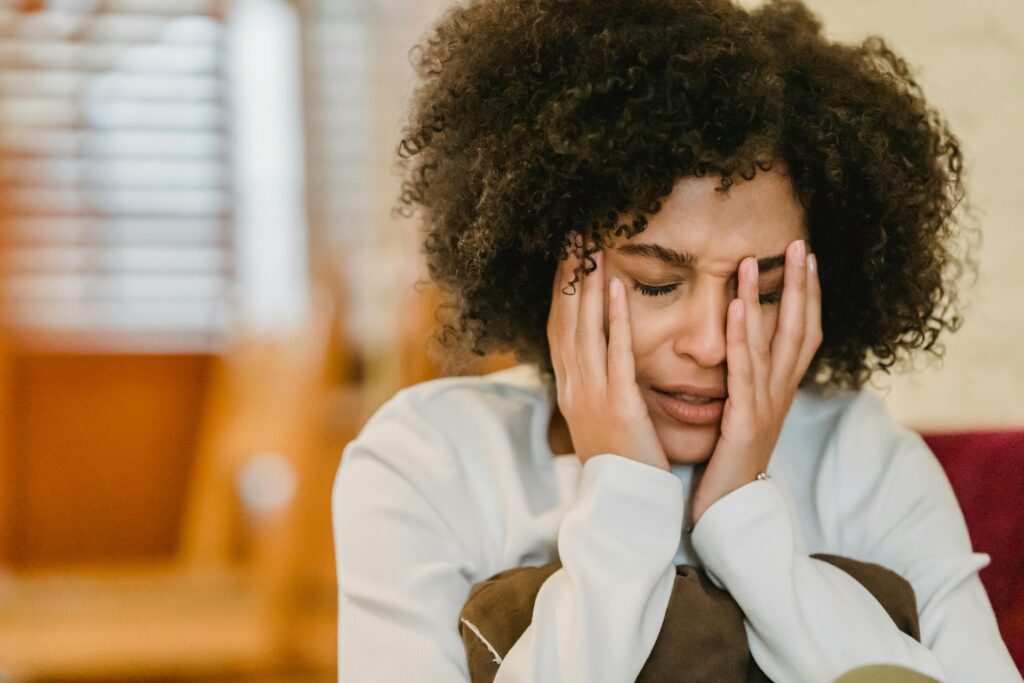
Why It Sits So Close To Anxiety In The Body
Here is the part that surprised me most when I understood it.
That skin crawling, get off me, maxed out feeling lives in the same part of your body as anxiety. They are nervous system cousins. Touched out is your body in a heightened, on alert state, and that is the exact same state anxiety runs on.
Think about what touched out actually feels like physically. The racing edge. The tightness. The sense that you need to escape your own skin. The way one more demand might make you snap or cry.
Those are not just emotional reactions. They are the signs of a nervous system stuck in high alert, the same place anxiety lives.
This is why touched out can tip so quickly into feeling panicky or tearful. You are not overreacting. Your body is already running hot, and one more touch is asking it to climb when it has nothing left.
Understanding this changed how I treated myself in those moments. I stopped thinking what is wrong with me and started thinking my system is overloaded and it needs to come down. That small shift is everything, and it is exactly the difference I wrote about in the difference between tired and touched out and why it matters.
The Night I Pulled Away Before I Even Knew I Was Doing It
I want to tell you about the moment I understood how empty I really was.
I was sitting at the dinner table on an ordinary evening. Nothing dramatic was happening. My boyfriend came up behind me and gently put his hand on my shoulder.
And I pulled away before I even knew I was doing it.
We both froze. Both shocked. That flinch was not a decision and it was not about him. My nervous system was so completely full that it slammed the door before my brain had any say in it.
I had not been touched by someone who did not need something from me in so long that even a loving hand landed as one more demand on a body that had no room left.
That was the moment I knew how empty I actually was.
It was not that I had stopped loving him. It was that I had given so much contact to so many small people all day that I had nothing left for the contact I actually wanted. My body could not tell the difference anymore. A touch was a touch, and they were all too much.
If your body has started flinching at things it used to welcome, please hear me. That is not coldness. That is depletion speaking through your skin.

Tired And Touched Out Are Not The Same Thing
This is worth slowing down on, because we mix them up constantly.
Tired is about energy. You are tired when you have not slept, when your body is heavy, when you would do anything to lie down. Rest fixes tired.
Touched out is about input. You can be wide awake and well rested and still be completely touched out, because the problem is not low energy, it is too much sensation.
This is why a nap does not always fix it. You can sleep eight hours and still flinch when someone touches you, because your nervous system needs less input, not just more rest.
The cure for tired is sleep. The cure for touched out is space. Quiet. No new sensation landing on your body.
Mixing these up is why so many of us feel like nothing helps. We keep trying to rest our way out of an overstimulation problem.
When you can tell the two apart, you can finally give your body what it actually needs in the moment. I broke down exactly how to spot the difference in the difference between tired and touched out and why it matters.
When Your Body Feels Like It Is Not Even Yours
There is a deeper layer to touched out that nobody warns you about.
After enough time being constantly available to be touched, held, climbed on, and leaned against, your body can start to feel like it is not yours anymore. Like it is communal property. A piece of equipment everyone has access to.
When your body has belonged to everyone else all day, it stops feeling like it belongs to you, and that is a quietly devastating thing to carry.
You forget what it feels like to inhabit your own skin without someone needing something from it. You lose the sense of your body as yours, a place you live, rather than a service the family uses.
That is not a small thing. It is part of why touched out can feel so lonely and so disorienting.
Reclaiming your body, even in tiny moments, is not selfish. It is how you come back to yourself. If that feeling of your body not belonging to you is hitting hard, you are far from alone, and why your body feels like it does not belong to you anymore puts gentle words to it.

Why You Still Cannot Relax Once Everyone Is Asleep
Here is the cruel twist that touched out plays on you at the end of the day.
You finally get the kids down. The house goes quiet. Nobody is touching you. By every logic you should melt into the couch and feel the relief flood in. And instead you sit there wired, restless, unable to settle, even though the thing overwhelming you has finally stopped.
This confuses so many of us. The input ended, so why has the overload not?
Because a nervous system that has been in high alert all day does not switch off the second the noise stops. It takes time to come down, and most evenings do not give it that time. You go from full demand straight to trying to relax, with no transition in between, and your body simply cannot make the jump that fast.
The touched out feeling lingers long after the last little hand has let go of you.
This is why you can be desperate to rest and completely unable to. Your body is still braced for contact that is no longer coming. It is still running hot from a day it has not been allowed to discharge.
Understanding this stopped me from feeling broken on the evenings I could not unwind. I was not failing at resting. My system just had not landed yet. If this is your nightly experience, why you cannot relax even when the kids are finally in bed explains exactly what your overloaded body is still doing after lights out.
The quiet is not enough on its own. Your system needs help coming down, not just an absence of noise.
What Actually Helps When The Gate Slams Shut
So what do you do when touched out hits and your body has already closed the door.
The instinct is to push through it, to feel guilty, to force yourself to accept the hug anyway. Please do not. Forcing a maxed out nervous system to take more input does not build tolerance. It just deepens the overload.
What helps is bringing your system down, not pushing it up. Here is what I reach for.
- Create even a tiny border. Step back. Put your hand up gently. Buy your body two feet of space before you do anything else.
- Discharge the overload physically. Touched out lives in the body, so the way out is through the body, not through talking yourself out of it.
- Lower the input fast. Less noise, less light, less contact, even for ninety seconds. Your system needs subtraction, not effort.
You cannot always leave the room. The toddler is still there, the dinner is still cooking, the day is still happening. So you need something you can do right where you stand, in your own body, in about the time it takes to boil a kettle.
That is exactly why I made the 2 minute body reset. It is a quick way to bring your nervous system down out of high alert when the gate has slammed shut and you cannot escape the room. Two minutes. No equipment. Just your body coming back down to safe.
You Are Not Cold. You Are Carrying Too Much.
So here is what I need you to take with you.
Touched out is not a character flaw and it is not a mood you should be able to shake off. It is a real, physical, nervous system event that lives right next door to anxiety. That get off me feeling is your body, maxed out and on high alert, asking for less, not loving you less.
The flinch is not coldness. The recoil is not rejection. They are the sounds a full nervous system makes when it has nothing left to receive.
So the next time your kid climbs on you and every cell says please, no, do not pile guilt on top of overload.
Give your body the space and the reset it is begging for. Reach for the 2 minute body reset and let your system come down.
You were never cold.
You were just carrying more than one body was ever meant to hold. 💛