
You pulled away when he touched your shoulder.
It was not a dramatic move. You probably did not even mean to do it. Your body just got there before your brain did. One second his hand was on you and the next you were out of range.
Then you felt awful about it. Because you love him. You wanted to want the touch.
This is the part of motherhood nobody warns you about.
Your body feels like it does not belong to you anymore, and it is not your fault.
If you have been walking around feeling like a stranger in your own skin, please hear this first. You are not broken. You are not cold. You are not failing at being a partner or a woman. You are touched out. You are completely depleted. Your nervous system is trying to protect you the only way it knows how.
This post is about why your body feels this way. What it is actually doing when you flinch or freeze or pull back. Why the guilt is a lie. And how to start coming home to yourself without leaving the house.
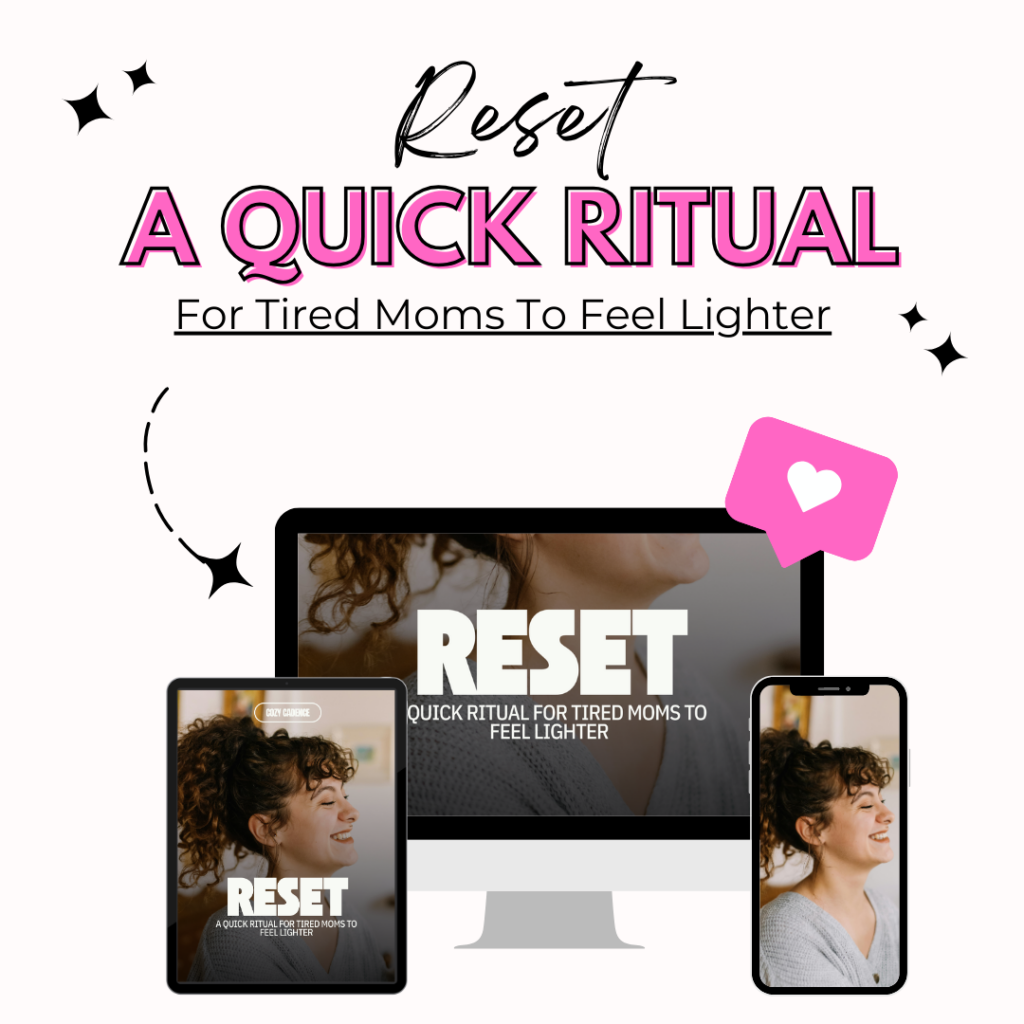
Feel Lighter in Minutes, Even on the Heaviest Days
RESET is a simple calming ritual that helps tired moms unload mental overwhelm, regulate their nervous system, and return to the day with clarity and steadiness.Why Your Body Feels Like It Does Not Belong To You Anymore
Your body has not been just yours in a very long time.
It grew humans. It fed them. It still carries them when they are tired and catches them when they fall and holds them through fevers at two in the morning.
During the day it is leaned on and climbed on and laid across. Someone is always touching some part of it. Even the parts you forgot existed. Elbows. Collarbones. The tiny bit of skin above your knee.
By evening your skin feels like a crowd has walked across it.
By the time your partner comes near you at the end of the day, your body is not available in the way he thinks it is. It is not closed to him because it loves him less. It is closed because there is nothing left to give.
That is not a marriage problem. That is a capacity problem. They look similar from the outside but they are different species entirely.
Touch aversion in motherhood is one of the most under-talked about things I can think of. Moms go years thinking they are the only one who feels this way. They are not. They are just the only one saying it out loud on a Tuesday morning.
Your body is not rejecting him. Your body is rejecting one more input on a day that has already absorbed a thousand.
The Silent Math Of Being Needed All Day
Think about a regular day.
Someone wants breakfast. Someone wants a different breakfast. Someone cannot find a sock. Someone is crying about the sock. Someone spills juice. Someone needs their hair done. Someone wants a hug. Someone wants to sit on you while you drink your coffee.
This is not even eight in the morning yet.
Every one of those is an input. Every one of those is your body being physically pulled into someone else's emotional state. Every one of those takes a tiny withdrawal from an account that does not refill automatically.
By midday your body has been withdrawn from fifty times and deposited into zero times.
You do not feel it happening because you are busy. You feel it in small strange ways. A flinch. A lock of your jaw. A weird resentment that shows up for no reason. A sudden need to hide in the pantry and eat something salty alone.
This is the silent math of motherhood. Ambient withdrawal. All day. Every day. For years.
By the time bedtime rolls around and someone touches your arm with real intention and affection, there is nothing there to receive it. Not because he did anything wrong. Because the account was already empty by nine thirty in the morning.

What Being Touched Out Actually Does To Your Nervous System
Touched out is a real thing happening inside your body.
It is not a feeling you made up. It is not you being dramatic. It is your sensory nervous system lighting up in the same way it would if you had been standing next to a blender for six hours.
Humans are only built to process so much input per day. Skin contact is a huge input. Emotional contact is a huge input. Noise is a huge input. Smells are a huge input.
Moms process more of all four of those every single day than almost any other category of person on earth.
Your body is not being precious when it reaches the point where it cannot take one more thing. Your body is at its actual sensory limit.
What your nervous system does at that limit is clever and also brutal. It starts filtering out touch before it fully registers. It starts pulling back on its own. It stops differentiating between demand touch and loving touch because it cannot afford the extra processing. So it just blocks everything coming in.
That is why kind touch feels the same as demanding touch once you are at that point. It is not a feelings problem. It is a processing problem.
Once you know this, you stop taking it personally. Which means he stops taking it personally. Which means the whole thing starts to soften a little, very quietly, on its own.
Why You Flinched When He Touched Your Shoulder
I want to tell you about a specific moment.
I was sitting at the dinner table. Nothing was wrong. It was not a bad day. The kids had eaten. The plates were still on the table. I was just sitting there, in the way you sit when you have finally let yourself slump for the first time in hours.
My boyfriend came up behind me and put his hand on my shoulder. It was a nice thing. A small everyday hand on a shoulder.
I pulled away before I even knew I was doing it.
He froze. I froze. We both stood there looking at each other like we did not know who had just done that.
That was the moment I realised how empty I actually was.
Not sad. Not angry. Not unloved. Empty in the specific way that your body stops being able to receive anything when it has been giving for too long.
That flinch was not a message about him. It was a message from my body to me. And I had been ignoring the small quieter versions of that message for months.
If your body has been sending you the small flinches and the quiet pull backs and the strange evenings where nothing sounds good, that is the same message. Your body is not broken. Your body is trying to be heard. 💛

The Guilt That Comes With Needing Distance
The worst part of being touched out is not actually the touched out.
It is the guilt.
It is the way you tell yourself you are supposed to want more. The way you compare yourself to some imaginary couple in a Sunday commercial who are always laughing and always affectionate and somehow also have four kids under six. The way you wonder if something is wrong with you.
Nothing is wrong with you.
The guilt is not yours. The guilt is a hand me down from a culture that has never understood what mothering actually takes out of a woman.
You have been told your whole life that a good partner is always available. You have been told that wanting space means you love him less. You have been told that a healthy relationship looks like constant closeness, constant affection, constant easy yes.
That is not true for any adult, and it is especially not true for a woman whose body is the main physical resource for three small people from the moment she wakes up until the moment she finally closes the door on them at night.
Needing distance is not a marriage problem. Needing distance is a basic maintenance requirement. The guilt is the part that keeps you from giving yourself the distance you actually need. Which is what makes everything worse.
Let the guilt sit next to you. Do not argue with it. Do not obey it either. Just let it be there while you take care of yourself anyway.
How To Come Back Into Your Body Without Leaving The House
You do not need a retreat. You do not need a whole weekend. You do not need to book a hotel room and disappear for three days to find yourself.
You need to send your body small consistent signals that it is not currently on duty.
Signals your body actually understands:
- A hot drink held in both hands for as long as you want to hold it
- Leaving the room when someone is loud and not explaining why
- Sitting down with no one in your lap for fifteen minutes
- A long shower with the door locked
- Not responding to a "Mom" until you have finished your own sentence
These are tiny. These look like nothing from the outside. These are the actual difference between a body that stays empty forever and a body that slowly remembers it belongs to you.
Coming home to your body is not one big moment. It is a thousand small repetitions of you saying, quietly, this part is mine.
A simple reset ritual helps here too. Just something you do once a day that belongs only to you, where nobody can ask you anything, and you are allowed to feel like a mammal instead of a system.
If you want a gentle place to begin, this is a good first step.
You do not need more than that. You just need to actually do it.

What Changes When You Start Taking It Seriously
Your body is slower to forgive than your mind is.
When you start honouring the touched out signals instead of fighting them, your body does not trust you immediately. It has been betrayed too many times. It takes a few weeks before it stops bracing for the next denial of its needs.
But it does start to soften. Slowly. Quietly. Almost imperceptibly at first.
You notice you are not flinching anymore. Not at the small touches. Not at the sudden ones.
You notice you can be leaned on for a minute without feeling your body scream at you to get up.
You notice you can sit through a hug without silently counting the seconds until it ends.
You notice your own body starting to come back to you like a cat that stopped hiding under the bed. That is not a metaphor. That is exactly what it feels like.
And then something else happens. You start to want touch again. Not because you should. Because your body has capacity for it again. That is different. That is clean.
This is the thing nobody tells you. Touched out is not a permanent state. It is a depletion signal. Feed the depletion and the signal quiets. It really is that simple and also that hard at the same time.
You Are Not Broken. You Are Full.
If you take only one sentence from this post, please take this one.
You are not broken. You are full.
Your body is not cold. Your body is overbooked. Your body is not rejecting the people who love it. Your body is at capacity and has stopped letting anything else in, because that is what bodies do when they are at capacity.
That changes the whole story.
A broken thing needs fixing. A full thing needs space. They are treated completely differently.
If you have been trying to fix yourself for years and nothing is working, it is because there is nothing actually wrong with you. You have been trying to solve a capacity problem like it is a character problem. That is why it never works, and that is why you keep ending up back in the same place feeling like the failure must be you.
It is not you. It has never been you.
You cannot fix being empty by trying harder. You can only fix it by pouring in something that is yours. Quiet. Space. Time. A hot drink. A locked door. Ten minutes where nobody can reach you and the only requirement is that you breathe.
That is not selfish. That is how full things get room to be full of the right thing again.

Conclusion
The way your body feels right now is not forever.
It is a signal. It is a protest. It is a tired little system asking you to please stop ignoring the fact that it has been running on fumes for a very long time.
You are allowed to need space. You are allowed to flinch. You are allowed to not want to be touched for a whole evening for no reason other than you already were, by a thousand tiny hands and hugs and leans, all day long.
Your body is on your side. It always has been.
If you want one small doable ritual to start taking back your own skin, RESET is a quick calming practice that fits into whatever mess your day already is. It takes minutes. It is the gentlest place I know to begin coming home to yourself. 💛