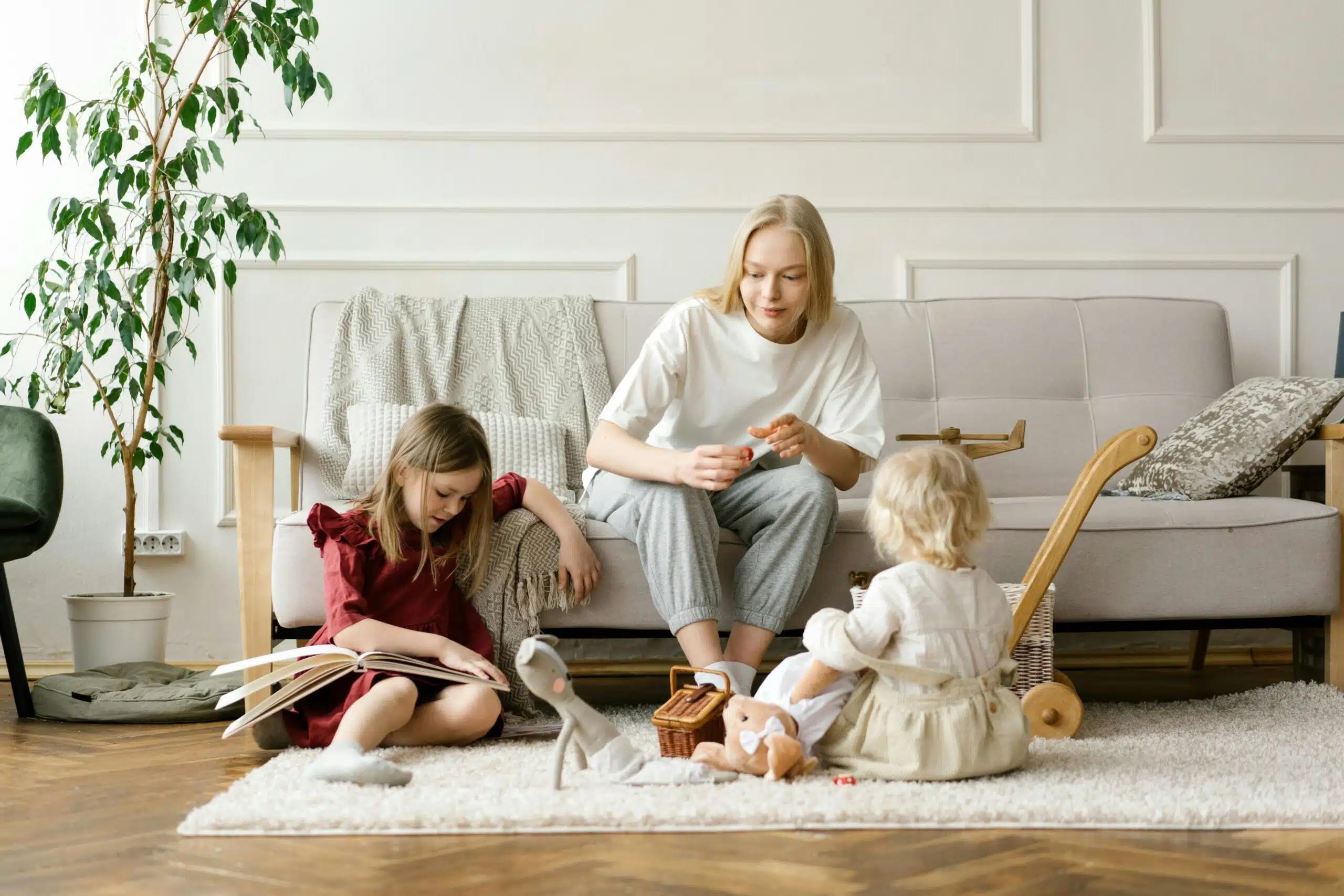
There is a specific kind of loneliness that does not look like loneliness from the outside.
It looks like a full house. It looks like chaos and noise and being needed every single minute of every single day. It looks like someone who clearly has plenty of people around her.
But inside? Inside there is a woman who cannot remember the last time someone asked her how she actually was. Not how the kids are doing. Not how the schedule looks. How SHE is. As a person. With thoughts and feelings and a life that exists beyond managing everybody else’s.
A new study gave this feeling a name. Researchers started distinguishing between social loneliness, which is about not having enough people around you, and emotional loneliness, which is about not being known. Not being seen as a person. Just being needed, constantly, without pause. And they found that moms, especially moms of young children, score higher on emotional loneliness than almost any other group.
You are not imagining it. You are not dramatic. You are surrounded by people who need you and somehow still deeply, quietly alone.
This post is about what loneliness in motherhood actually feels like, why it happens, what it does to your nervous system, and what genuinely helps.
What Research Actually Says About Mom Loneliness
Loneliness research has been quietly evolving over the last decade, and one of the most important shifts has been this: scientists stopped measuring loneliness only by how many people you have around you and started looking at whether those people actually know you.
The traditional understanding was about quantity. You have friends, a partner, children, a family, neighbours who wave. So you cannot possibly be lonely. But the newer research distinguishes between social loneliness and emotional loneliness, and the difference matters enormously for moms.
Emotional loneliness is not about who is in the room. It is about whether anyone in the room sees you as a person.
Researchers call the psychological process of becoming a mother “matrescence,” and they have been studying how massive and largely unwitnessed this identity shift is. You changed. You changed enormously. You became a different version of yourself, with different needs and fears and daily rhythms. And the people around you mostly just watched it happen without realising anything significant had occurred.
Nobody sat with you in the becoming. Nobody asked who you were turning into or what you were quietly leaving behind. You just changed, in the middle of the logistics and the night feeds and the relentlessness of it all, and the world kept moving around you like nothing happened.
Study after study shows mothers describing a persistent feeling of invisibility even inside full, busy households. They are not alone. But they are profoundly unseen. And that gap, between being surrounded and being known, is where mom loneliness lives.
It is real. It has a name. And knowing that changes something.

Why Being Surrounded By People Makes The Loneliness Worse
Here is the part that feels almost impossible to explain to someone who has not been inside it. Being surrounded by people who need you does not protect you from loneliness. In some ways, it makes it sharper.
Because when you are actually alone, the absence of connection is visible. You can name it. You can address it. You can call a friend or leave the house or reach out. The gap is obvious.
But when you are surrounded by people who need things from you all day, the loneliness hides inside the noise.
It hides inside the being needed. It hides inside the busyness. It hides inside the full calendar and the overflowing inbox and the dinner that still needs to be made. Nobody looking at your life from the outside would think to worry. You look like someone who has plenty of people. You look like someone who is managing.
So you do not say it out loud. What would you even say? I am surrounded by people and I have never felt so alone. It sounds ungrateful. It sounds like you do not appreciate what you have. It sounds dramatic and self-indulgent and very hard to justify when there are children who need feeding and a partner who would genuinely be baffled.
So you carry it quietly. And the quieter you carry it, the lonelier it gets. Because now you are not just unwitnessed. You are not even telling anyone that you are unwitnessed. You are invisible and pretending you are fine with it, which is a particular flavour of exhausting that has nothing to do with sleep.
This is the loop. And most tired moms are caught inside it.
The Moment You Stop Existing As A Person And Become A Function
I know exactly when it happened for me.
It was an ordinary evening, nothing dramatic. My boyfriend came up behind me and put his hand on my shoulder while I was sitting at the dinner table. I pulled away before I even realised I was doing it. We both froze. Both shocked.
In that moment I understood that I had been running so empty, so completely used up by the day and the week and the accumulated weight of being needed, that I had stopped existing as a person who could receive care. I had become a function. A logistics system. A soother of feelings, a maker of dinners, a scheduler of everything.
And somewhere in the becoming all of those things, the part of me that was just me had gone very quiet.
The thing that scared me was not the pulling away. It was how gradually it had happened. It was not one big moment. It was a thousand small ones. The dinners made while overstimulated and not quite present. The conversations managed while half somewhere else. The needs met while mine went quietly unnoticed. Nobody was being cruel. Life was just being life.
But the cumulative effect of being needed without being known is that you stop expecting to be known. You stop mentioning how you are doing. You stop asking for things. You stop taking up space with your own interior life because there never seems to be room for it anyway.
And then one ordinary evening, someone reaches for you, and you cannot let them in.
If you recognise this and you are running on empty right now, RESET is where I would start. It is a simple ritual for exactly this moment, when you have been pouring out for so long that you need somewhere to put what you are carrying before you can even think about finding your way back.

Why Your Partner Does Not See The Loneliness In Motherhood
I want to be careful here because it is easy to make this a post about how partners are failing us. And sometimes, honestly, that is absolutely the story. But it is not the whole story, and I do not want to skip the more complicated part.
Most partners genuinely do not see the emotional loneliness because they are not looking for it.
They see a woman who is busy, competent, managing, and present. They do not see that the managing is costing her everything she has.
They do not see it because you have probably not told them in terms they can actually understand. Not because you are doing something wrong. But because how would you put it into words? “I feel unseen” sounds vague. “I am lonely” sounds like an accusation. “I don’t know who I am anymore” sounds like a crisis requiring a big response, and you genuinely do not have the energy for a big response right now. So you say “I’m fine” or “just tired” and they take you at your word because they love you and want things to be okay.
There is a different dynamic at play too, which this post on the invisible load of motherhood and why your partner does not see it explains much better than I can in a paragraph. The short version is that the invisibility is structural. It is built into how most households distribute responsibility. It is not entirely personal even when it feels intensely personal.
And the loneliness you are feeling is not only coming from your partner. It is coming from the structure of modern motherhood. From the loss of the village. From a culture that celebrates the sacrifice without ever asking about the cost. From a world that called you resilient and forgot to notice it was running you ragged.
The Invisible Grief Of Not Being Known Anymore
There is a grief inside this loneliness that almost never gets named.
Before you were a mom, you had a self that was legible to the world. People knew your opinions. Your sense of humour. The particular way you thought about things. Your interests and passions and the kind of person you were in a room full of people.
That self does not disappear when you become a mother. But it does get quieter. It gets buried under the constancy of the need. And slowly, over months and sometimes years, it starts to feel like a stranger. Even to you.
You forget what you like. Not in a dramatic way. In a Tuesday evening way. Someone asks what you want to watch and you genuinely stare at them. Someone asks what you want for your birthday and you cannot form an answer in any language.
This is the grief of it. The quiet erosion of knowing yourself. And the painful part is that nobody around you knows to mourn it with you. Because they never saw you disappear. They just see the mom who is doing a lot. They do not see the whole person underneath, very quietly trying to remember that she exists beyond the function.
If you are not sure how empty you actually are right now, this post on signs you are running on an empty emotional tank is worth an honest read. Sometimes naming where you are is the first genuinely useful thing.
What The Loneliness Is Doing To Your Nervous System
This is where it stops being about feelings and starts being about biology.
Humans are wired for connection at a neurological level. We are not just emotionally designed to feel seen. We are physiologically regulated by it. The process researchers call coregulation, the soothing that happens when one person’s calm steadies another person’s nervous system, is not just a childhood mechanism. Adults need it too. All of us. All the time.
When you are not being seen, when you are constantly the one giving and managing and steadying, your nervous system does not just feel lonely. It starts to dysregulate.
You find yourself moving to anger faster. Crying at things that would not have touched you a year ago. Feeling a bone deep exhaustion that more sleep does not fix.
This is not weakness. It is your body telling you that it has been running without being replenished. That the withdrawals have been outpacing the deposits for a long time. That something real needs to change, not because you are broken, but because you are human and humans cannot sustain continuous output without receiving something back.
The connection between this kind of loneliness and mom burnout is direct. They are not separate problems. Feeling unseen is one of the most reliable ways burnout builds quietly, without announcing itself, until it is already deeply entrenched. Your body has been keeping score. It has been waiting for you to notice.

The Small Things That Slowly Rebuild You
I want to be honest: the loneliness of motherhood does not have a quick fix. It is structural. It lives inside the way modern family life is built, inside the loss of community and the isolation of the nuclear household and a culture that never accounted for the cost.
But something can help. And you do not have to wait for the perfect conditions to start feeling more like a person again.
The first thing is naming it. Out loud, to yourself or to someone who can hold it. Not just “I am tired.” Specifically: I am lonely. I miss being known. I cannot remember the last time someone asked about me. That naming is not self-pity. It is the most honest and useful thing you can do right now.
The second thing is finding spaces where you are seen as a person, not only as a parent. A friend who actually asks about you and waits for the real answer. A community where you can say the true things and have them received without immediate advice. Somewhere you get to be a whole human.
The third thing is noticing the small moments where you catch yourself. Where you have an opinion, or a genuine laugh, or a thought that is entirely your own. And letting that be enough for today.
And if you are running so empty that even those small things feel impossibly heavy, RESET is a gentle and honest place to start. It is a simple ritual designed for exactly the moment when you have nothing left and need somewhere to set down what you are carrying before you can even think about finding your way back.
You Were A Person Before You Were A Mom. She Is Still In There.
The loneliness in motherhood does not want you to remember this.
You existed before the children, before the schedules, before you became someone’s everything. You had dimensions and opinions and a self that was genuinely interesting and not defined entirely by your ability to keep small humans alive.
She did not leave when you became a mom. She went quiet. She got buried. She is underneath the exhaustion and the logistics and the feeling of being invisible, waiting for a moment of space to breathe.
The loneliness you are feeling is not a sign that something is wrong with you. It is a sign that you need more of yourself back. That you have been pouring out for so long that you started to forget where you end and the needs begin.
You deserve to be known. You deserve to be asked about. You deserve to take up space as a person, not only as a parent.
And you do not have to earn that by getting everything right first. You can start now, exactly as you are, tired and slightly chaotic and very much still in there. 💛

Wendy Venema
A late-realized AuDHD mom in a blended family of seven. I write the posts I needed when I was crying on the bathroom floor.
Read my story