
New parental burnout research found something unexpected: exhaustion and closeness with your kids do not cancel each other out, and both can grow together.
New research on parental burnout found something nobody quite expected. Exhaustion went up. And so did how close parents feel to their kids.
Not one instead of the other. Both, at the same time, in the same tired, overextended households.
If you are reading this feeling completely wrung out and also fiercely, achingly close to your kids, both of those are true. Neither one cancels the other out.
A 2025 study out of the University of Wisconsin-Madison and Georgetown University, published in Translational Issues in Psychological Science (Kerr et al., 2025), found that a parent’s exhaustion and their emotional distance from their kids were not directly linked. That pattern echoed an earlier 2023 study by Blanchard and colleagues. Burnout and closeness, in other words, are not measuring the same thing.
So let’s talk about what the research actually found, why it sounds wrong at first, and why your hardest season might be quietly building something you cannot see yet from the inside of it.
What The Research Actually Found
Researchers tracked parents’ daily reports of exhaustion, overwhelm, and emotional distance from their kids over three weeks, alongside how close they felt in good moments and bad ones. The 2025 study, led by Margaret Kerr and Heather Kirkorian’s team, followed 401 parents of toddlers through 21 daily diary check ins.
The finding that stood out: exhaustion and emotional distance from kids were not directly linked in any of the models. A parent could be more exhausted on a given day without becoming more distant from their child that same day.
This echoed an earlier finding from Blanchard and colleagues (2023): positive moments with kids predicted feeling less distant the next day, even on days that were otherwise hard. Burnout, it turns out, is not one single slide toward disconnection. It is several different things happening at once, and they do not always move together.
Why This Doesn’t Sound Right At First
Our instinct says exhausted and connected should not go together. Exhaustion usually makes us short tempered, distant, checked out. It seems like it should push people apart.
But burnout in parenting is not the same kind of exhaustion as burnout at a job you could simply quit. You cannot clock out of the relationship the way you can clock out of a role you hate. The exhaustion and the love are happening inside the exact same relationship, at the exact same time, tangled together in a way office burnout never has to be.
I think part of why this feels so counterintuitive is that we have absorbed a cultural story where a good parent is supposed to look calm, rested, and endlessly patient. Burnout looks like the opposite of that picture, so we assume the relationship underneath must be suffering too. The research suggests our kids are not grading us on how rested we look. They are registering whether we kept showing up, tired face and all.

How Both Numbers Can Be True At Once
Here is the part that finally made sense to me. Closeness is not built primarily from ease. It is built from shared experience, especially shared hard experience.
Every meltdown you weathered together, every hard bedtime, every sick night with a fever, was also a moment of your kid learning they could fall apart completely and you would still be there. That is the exact material trust and closeness are made from.
Burnout and closeness are simply measuring two different things:
| Burnout | Closeness | |
|---|---|---|
| What it measures | How depleted your resources are | How much your relationship has been through and stayed intact |
| Moves with | Sleep, workload, support, capacity | Shared experience, especially the hard kind |
| Goes up when | Demands outpace your resources | You keep showing up, not just on the easy days |
| Goes down when | You refill your capacity | Someone stops showing up |
One going up does not require the other to go down. They are not even on the same scoreboard.
Can You Be Burned Out And Still Be Close To Your Kids?
Yes. The Kerr et al. (2025) findings and the Blanchard et al. (2023) study before it both found exhaustion and emotional distance moving independently, not in lockstep. Being depleted does not automatically mean you are failing at connection.
Mikolajczak and colleagues, in their 2023 review of fifteen years of parental burnout research published in Current Directions in Psychological Science, describe burnout as a mismatch between parenting risks and parenting resources, not a verdict on how much a parent loves their kids. Burnout is about capacity. Closeness is about what your relationship has survived together. Those are different questions with different answers.
The Season We Almost Did Not Survive As A Family
I think about the early days of blending our family constantly. Six of us, two sets of kids, learning to live together under one roof with none of the shortcuts a family builds over years of just being together from the start.
There was a night, early on, when I cooked dinner for everyone while completely overstimulated by the kids fighting at the table. After dinner everyone scattered outside to play, leaving me alone with a mountain of dishes and no dishwasher. His kids, old enough to help, had simply never been asked to. I lost it completely at that sink.
My boyfriend gently suggested maybe we should not even try this. I told him very clearly I was not a quitter, then did every dish anyway, seething the entire time. That season nearly broke something in me.
Five years later, that same blended family is the closest, warmest thing in my life. We did not get here despite the hard nights. We got here partly because of them, because we kept choosing each other through the exhausting parts instead of only through the easy ones.

Burnout Is Not The Opposite Of Connection
A lot of us have quietly believed that if we are burned out, we must be failing at the connection part too. That the exhaustion is proof we are not present enough, not patient enough, not doing motherhood well enough for real closeness to be happening underneath it.
This research directly contradicts that fear. You can be completely depleted and still be building something real and lasting with your kids at the exact same time. One is not evidence against the other.
If burnout has had you questioning whether you are even showing up for your kids the way you want to, what mom burnout recovery actually looks like is worth reading. Recovery does not require you to have been disconnected in the first place. It just requires you to refill what got spent. And if what you are actually noticing lately is short fuses more than distance, the anger that shows up when you are running on empty is a companion piece worth reading too. That anger is a capacity problem, not a closeness problem.
Connection Does Not Require Energy You Do Not Have
Connection on the hardest days does not need to look like anything elaborate. It does not need a craft, a special outing, or even a particularly good mood on your part.
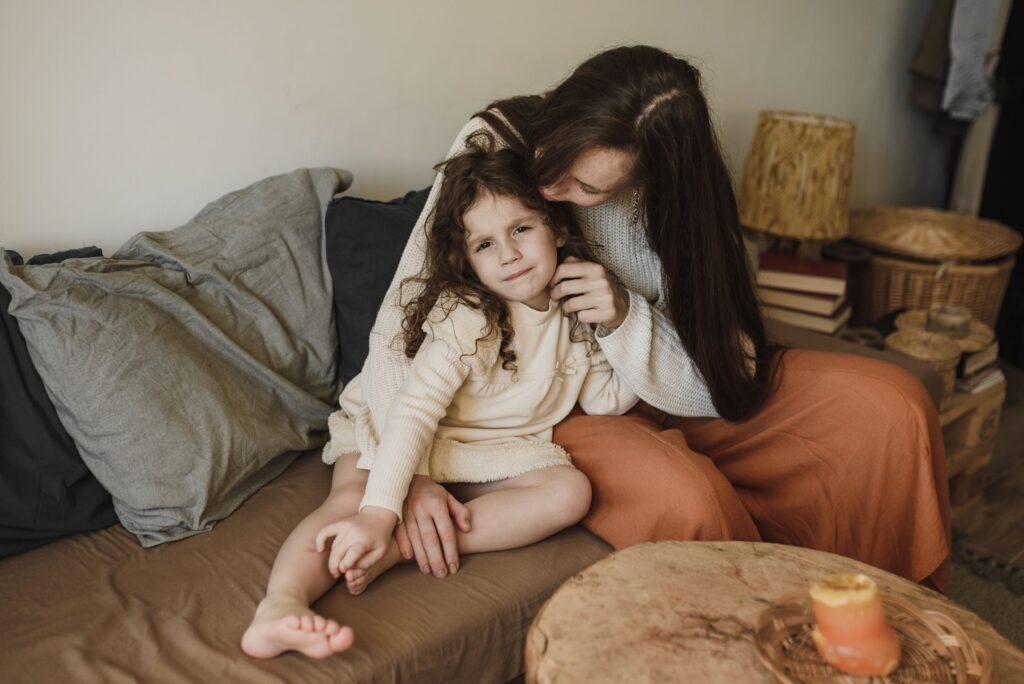
Some of the most connecting moments with your kids happen inside completely unremarkable, even exhausted, minutes. A hand held quietly while you both watch something on the couch. A tired hug at the door before school. Being the person they cried in front of without you flinching away from it.
If you have been assuming connection requires an energy reserve you simply do not have right now, building emotional connection with your kids on the hardest days is worth reading. None of it requires you to be well rested first. That is honestly the whole point.
If you want to understand this pattern more broadly, the research says you are not losing yourself, you are expanding, and it just aches like loss is a good companion piece here too. The ache and the growth are often the exact same experience wearing different names.
What This Means For How You Judge Your Hard Days
Stop using your exhaustion as evidence that you are failing your kids. Those are two separate scoreboards, and being low on one does not automatically mean you are low on the other.
A hard, depleting day can still be a day your kid remembers as safe, loved, and connected, simply because you stayed in the room even when it cost you something.
On the nights when the depletion feels bigger than the closeness, when you cannot feel anything except tired, that is usually your body asking for a real reset, not a bigger effort. Something quick enough to actually reach for at eight in the evening. That is exactly why RESET exists: for the moments when you have nothing left to give the connection until you have given something back to yourself first.
FAQs: Parental Burnout And Closeness
Q: Can you be burned out and still close to your kids? A: Yes. Research from Kerr et al. (2025) and Blanchard et al. (2023) both found exhaustion and emotional distance from kids move independently. Being depleted does not automatically mean your relationship is suffering.
Q: Does parental burnout damage your bond with your child? A: Not automatically. Burnout measures depleted capacity, not relationship quality. Closeness is built through shared experience, including hard experience, which is a separate process from how tired you are.
Q: What is the difference between burnout and emotional distance from your kids? A: Burnout is exhaustion, overwhelm, and depleted capacity. Emotional distance is a specific symptom some burned out parents experience, but research shows the two do not always move together day to day.
Q: How can I connect with my kids when I have no energy left? A: Low-effort moments count more than we think: a quiet hand held, a tired hug at the door, staying in the room during a meltdown. Connection does not require you to be rested first.
You Are Allowed To Be Both Depleted And Deeply Loved
You do not have to choose between recovering your own energy and staying close to your kids. Both things can be true, and both things need tending.
Refilling yourself is not selfish, and it is not evidence that you love them less. It is what lets you keep showing up for the hard nights that, it turns out, are quietly building the very closeness you were terrified burnout was costing you.
If today is one of those depleted days and you need somewhere to put some of what you are carrying down, even for a few minutes, that is exactly what RESET is for. It will not erase the exhausting season you are in. It might just help you have a little more left over for the closeness that is already quietly growing inside it.
Burnout and closeness were never supposed to cancel each other out. You can be completely wrung out tonight and still be raising kids who feel, right down to their bones, that they are deeply and unshakably loved.
Both numbers are true. Only one of them needs fixing.

Wendy Venema
A late-realized AuDHD mom in a blended family of seven. I write the posts I needed when I was crying on the bathroom floor.
Read my story