
Why does whining make me so angry when I can handle screaming? Your nervous system hears it as an alarm. Here is what happens inside you and what helps.
Last updated: 3 November 2026
A full blown scream? Fine, I can handle a scream. I have handled screams in supermarkets, in the car, at 3 in the morning with one sock on.
But that one long, nasal, slightly wobbly muuuuuum that slides up at the end like a question nobody asked? That one turns me into someone I do not recognise. 🫠
If you have ever typed “why does whining make me so angry” into your phone while hiding in the pantry, hi. You are in very good company. A 2026 national survey of 1,000 US parents by Lurie Children’s Hospital of Chicago found that 6 in 10 parents experience sensory overload, and children arguing or whining sits right at the top of the trigger list.
Here is the short answer: whining makes you angrier than screaming because your nervous system treats it as an alarm that will not switch off, and it arrives when your sensory system is already full. It is not a character flaw. It is biology meeting a very long day.
Below I will walk you through what your body is actually doing in that moment, why a scream ends and a whine just keeps going, the night I lost it over a pile of dishes, and what helps you not snap when the next muuuum comes floating down the hallway.
Why does whining make me so angry when I can handle a full scream?
Whining makes you angrier than screaming because it is built to be impossible to ignore, and it rarely ends on its own. A scream is a big, loud burst that peaks and then it is over. A whine is a drawn out, high pitched, repetitive sound that keeps asking you to do something, right now, forever.
Researchers at SUNY New Paltz actually tested this. In a study led by psychology professor Rosemarie Sokol Chang, published in the Journal of Social, Evolutionary, and Cultural Psychology in 2011, adults solved subtraction problems while listening to different sounds, including a high pitched table saw, a crying baby and a child whining. Whining caused more mistakes per problem than any other sound, including the table saw. 😅
Sokol Chang compared whining to a fire siren: unpleasant on purpose, because its whole job is to make you tune in. Parents and non parents were equally distracted. So no, you are not uniquely bad at tolerating it. The sound was designed to get under everyone’s skin.

What is your nervous system actually doing when you hear that muuuum?
When a whine hits an already full mom, her sympathetic nervous system switches on, which is the part of the nervous system that runs your fight or flight response. Your heart speeds up, your jaw tightens and your brain quietly decides that this sound is a threat that must be stopped immediately, by any means, including yelling.
Cleveland Clinic health psychologist Grace Tworek, PsyD, explains that sensory overload happens when input from any of your senses feels overwhelming and triggers a physical response. That response can fire even when there is no real danger. She lists irritability, trouble focusing and racing thoughts among the most common signs.
That is the whole story of the muuuum moment, really. Your body is not hearing “can I have a snack.” It is hearing a siren on top of the dishwasher, the TV, the dog, the clutter and the forty questions you already answered today.
The anger is not a reaction to your child. It is your body trying to make the alarm stop. If you want to go deeper on why constant sound lands like being touched too much, I wrote about how noise hits your body like too much touch.
Whining vs screaming: why does one sound land so much harder?
Screaming and whining hit your nervous system in completely different ways, and the difference is mostly about duration, pitch and demand. A scream usually signals that something happened. A whine signals that something is wanted, and that it will keep being wanted until you give in or lose it.
Here is how I explain it to myself on a bad afternoon:
| A full scream | A long whine | |
|---|---|---|
| How long it lasts | A burst, then it peaks and fades | Drawn out and repeated, sometimes for an hour |
| What it asks of you | Check that everyone is okay | Fix this, give this, do this, now |
| How your body reads it | Emergency, act fast | Alarm that will not switch off |
| What it does to focus | Grabs attention once | Keeps breaking your attention again and again |
| How you feel after | Shaken, then relieved | Drained, prickly, ready to snap |
There is something oddly honest about a scream. It is big and dramatic and then it is done, like a sneeze. 🤧
A whine is more like a dripping tap in the middle of the night. It is not the volume that gets you, it is the fact that it never resolves. Every repetition stacks on the last one until a tiny request feels like the final straw.
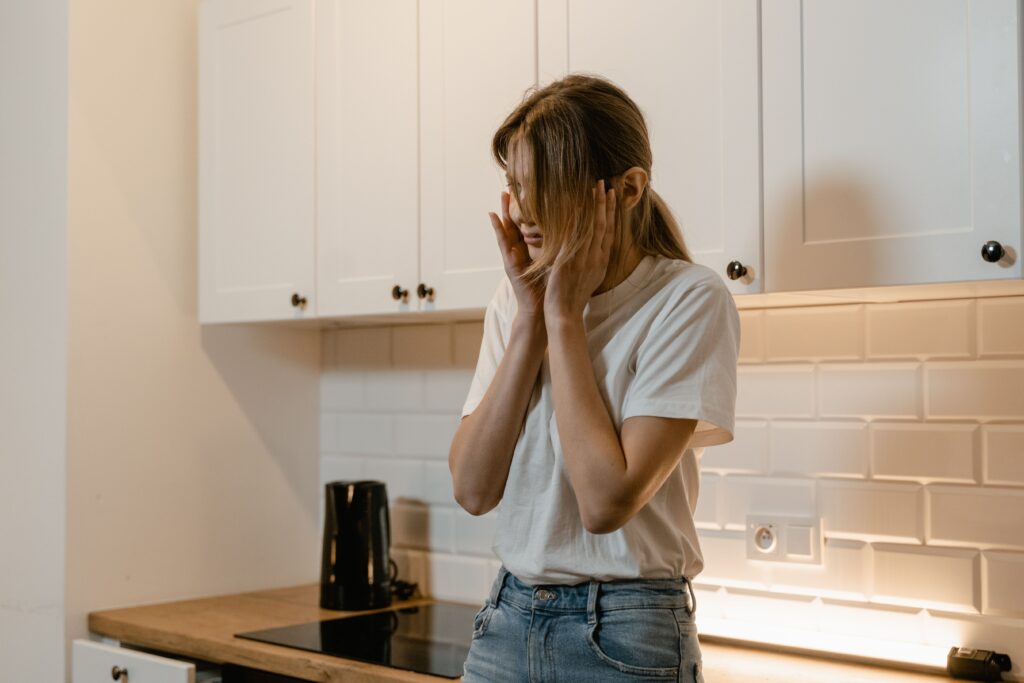
Why does the whining feel worse at 5pm than at 9am?
Whining feels worse late in the day because your sensory tank fills up from the moment you wake up, and by dinnertime there is simply no room left. The same whine that you shrug off at breakfast can make you see red at 5:30, not because the whine got worse but because your capacity did.
The Lurie Children’s Hospital survey backs this up. Parents named home as the place they felt overstimulated most often, with triggers like whining, siblings fighting, loud noise, constant talking and clutter. Parents of children under 5 were hit even harder, with 70 percent reporting overstimulation compared with 56 percent of parents of older kids.
Lead researcher Marie Heffernan, director of Voices of Child Health at the Stanley Manne Children’s Research Institute at Lurie and an assistant professor of pediatrics at Northwestern’s Feinberg School of Medicine, called parental overstimulation “a very common experience for parents in the U.S.” Common. Not rare, not broken, not a bad mom thing.
By late afternoon you are not reacting to one whine, you are reacting to the whole day. I wrote more about this slow build in why your house is a sensory minefield and you are fried by noon.
The night I lost it over a pile of dishes
The worst snap of my early blended family life was not about the noise itself, it was about a full nervous system with nowhere to put it. When my boyfriend and I first moved in together, we each had two kids. One evening I cooked dinner for six people while the kids fought in the background, loud and constant, and I could feel my brain start to crumble at the edges.
After dinner everyone vanished outside to play. I was left alone in the kitchen with every single dish and no dishwasher. His kids were nine and twelve, old enough to help, but in their world it was completely normal that someone would just handle it.
I lost it. Properly. My boyfriend suggested maybe we should not even try this whole living together thing, and I told him very clearly that I was not a quitter.
Then I did all the dishes anyway. Seething. 🫠
Looking back, those dishes were never the real problem. My sensory system had been full since the first argument over who got the blue cup, and the dishes were just the place it spilled over. That is exactly what a whine does at 5pm. It is the dish on top of the pile.

How do you stop snapping when the whining starts?
You stop snapping at whining by catching the surge in your body before it reaches your mouth, then lowering the total noise instead of trying to out tough the sound. Willpower alone does not work against a siren. What works is noticing earlier and giving your nervous system less to carry.
Here is what actually helps me:
- Name the alarm out loud. Saying “my body is really loud right now” to yourself pulls you out of autopilot for one breath.
- Notice the surge. Hot face, tight jaw, clenched hands. That is your sympathetic nervous system revving up, and it is your cue, not your fault.
- Turn something else down. Switch off the TV, the music or the noisy toy. You cannot control the whine, but you can lower everything around it.
- Breathe slow on purpose. Cleveland Clinic suggests counted breathing: in for three, hold for three, out for three. It takes about nine seconds.
- Answer the need, not the tone. Sokol Chang’s own suggestion was that figuring out what is underneath the whining may work as well as, or better than, ignoring it.
If you want a simple version you can actually remember mid whine, my free Snap Switch walks you through catching the surge, flipping the switch and responding with calm authority instead of regret.
Those three seconds before you snap are the whole game. I broke them down in more detail in the three seconds before you snap and how to catch them.
What if you already snapped at the whining today?
If you already snapped, you have not ruined anything, and the most useful thing you can do now is repair. Repair means going back to your child once you are calm, naming what happened in simple words and letting them know it was not their fault. Kids do not need a mom who never loses it, they need one who comes back.
Something as short as “I yelled because my body was full of noise. That was not okay, and I am sorry” is enough. You do not need a speech. You need the coming back.
Then turn the same kindness toward yourself, because the snap was a signal, not a verdict on who you are. If you want words for that conversation, here is the repair conversation you owe your kid after you lost it.
And if every little thing bugs you lately, not just the whining, that matters too. Constant irritability can be a sign of overload or depletion rather than personality, which I unpacked in why irritability can be a symptom, not a personality flaw.

FAQ
Why does whining bother me more than crying?
Crying usually signals pain or sadness, so your body softens and moves toward your child. Whining signals a demand that keeps repeating, so your nervous system reads it as an alarm. A 2011 SUNY New Paltz study found whining was more distracting than a crying baby, a table saw or ordinary speech.
Is it normal to feel rage when my child whines?
Yes, and you are far from alone. A 2026 Lurie Children’s Hospital survey of 1,000 US parents found 6 in 10 experience sensory overload, with whining among the top triggers. Feeling rage does not make you a bad mom, it means your sensory system is full and your fight or flight response has switched on.
Why is the whining worse when I am already touched out?
Being touched out means your body has had more physical contact and sensory input than it can process. When your tank is already full, one more input like a whine tips you over. That is why the same whine feels manageable in the morning and unbearable by dinner.
How do I stop yelling when my kid whines?
Catch the surge in your body first, then lower the other noise around you. Turn off the TV, take a slow counted breath and respond to the need behind the whine instead of the tone. A short plan you have practiced beforehand works better than willpower in the moment.
Does ignoring whining make it stop?
Sometimes, but not always. SUNY New Paltz psychologist Rosemarie Sokol Chang suggested that figuring out what your child actually needs may work as well as, or better than, ignoring the whining. Often a whine means a tired, hungry or overwhelmed kid who does not have better words yet.
The whine is not the enemy, your full tank is
Whining makes you so angry because it is an alarm built to be impossible to ignore, landing on a nervous system that has been absorbing noise all day. You are not too sensitive, too impatient or secretly a terrible person. You are a human with a body, in a house that is loud and sticky and full of people who need you.
The goal is not to become a mom who never feels the surge. The goal is to notice it a few seconds sooner, turn the volume of your day down where you can and come back when you slip. That is very doable, even on a Tuesday. 💛
If you want something small to start with tonight, grab my free Snap Switch and keep it close for the next muuuum. Because there will be a next one. There is always a next one. 😅

Wendy Venema
A late-realized AuDHD mom in a blended family of seven. I write the posts I needed when I was crying on the bathroom floor.
Read my story

