
Your child is not being dramatic.
They are not trying to ruin the afternoon. They are not doing this to you personally. They are not choosing this any more than you choose to cry when something overwhelms you and the tears just come anyway.
What is actually happening is something different. Something more fascinating, and more useful to know, than anything you will find in a list of calm-down strategies.
When a child is dysregulated, their brain is doing something specific. It is scanning the room for a co-regulated nervous system nearby. It is looking for a calm signal from someone outside of them, because it cannot produce that signal from the inside yet. The part of the brain that handles logic and perspective and talking about feelings in full, considered sentences is still developing. It will be developing until your child is in their mid-twenties. Until then, they borrow regulation from the adults around them.
That is co-regulation. And understanding it changes everything about how you read your child’s biggest, messiest, most impossible moments.
In this post, I am going to break down what co-regulation is, why your child’s brain literally cannot calm down without it, and what it actually looks like to offer it on a real Tuesday when you are also running on empty.
What Is Actually Happening In Your Child’s Brain When They Cannot Calm Down
When your child goes from completely fine to full meltdown in half a breath, there is something real happening inside their head.
The amygdala, the part of the brain that processes threat, has fired. It has decided that whatever is happening right now is an emergency. And once that alarm goes off, the prefrontal cortex, the thinking and regulating and “let’s talk about this calmly” part, goes offline. Not because your child decided to be difficult. Because a neural alarm system has physically cut access to it.
This is why logic does not work when a child is in that state. “But why are you crying?” falls flat not because your child is refusing to engage, but because the brain that could answer that question is genuinely not available right now. You are asking a flooded room to have a productive conversation.
The only thing that helps in that moment is a regulated nervous system nearby. Not advice. Not consequences. Not a calm explanation of why the behaviour is not acceptable. A body. A steady, present, regulated body that the child’s own nervous system can start to mirror.
This is backed by neuroscience, not just gentle parenting Instagram. The brain is a social organ. It is designed to read and respond to the nervous systems around it. Children, whose own regulation systems are still being built, are especially wired to scan the room for someone to borrow steadiness from.
Why your kid goes from zero to screaming in about four seconds gets into the full amygdala sequence in detail and it is worth reading alongside this one if you want the science to really land.
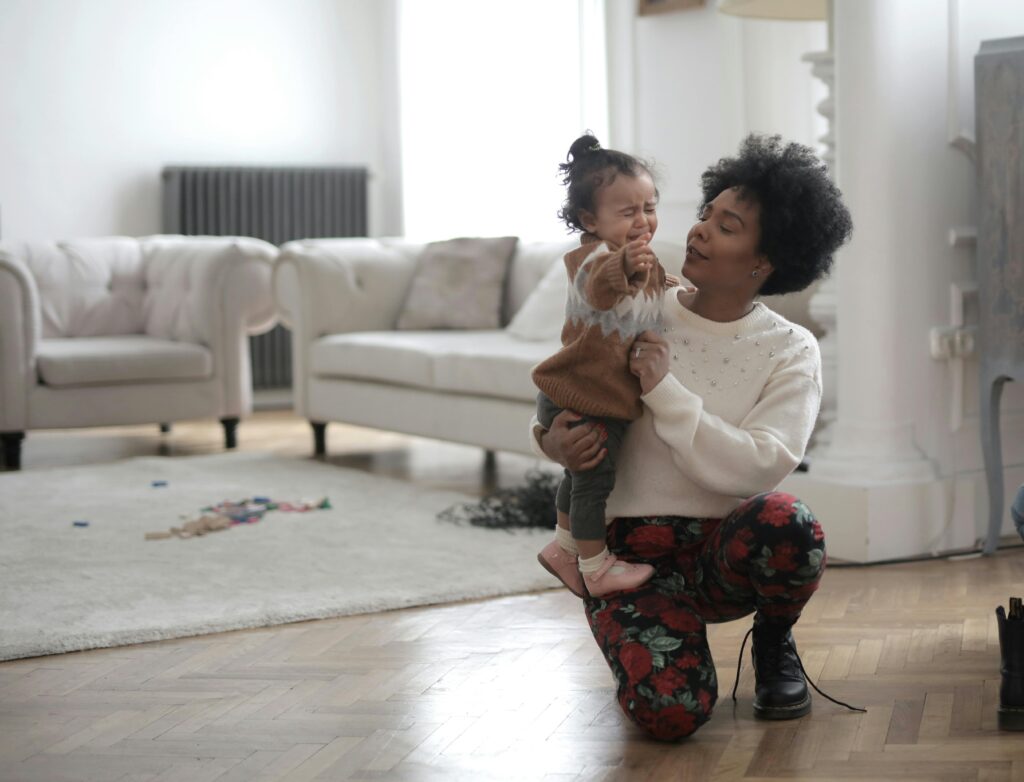
What Co-Regulation Is And Why Your Nervous System Is The Key
Co-regulation is not a parenting philosophy. It is a biological process.
It describes what happens when one nervous system helps another nervous system find its way back to calm. Adults do this for each other all the time. You are upset, a friend sits with you, their steadiness reaches you before any words do, and something in you starts to come down. That is co-regulation between two adults with fully developed prefrontal cortexes.
For children, it is not optional. It is the mechanism through which their entire emotional regulation system gets built. Every time a regulated adult shows up for a dysregulated child, that child’s brain is not just getting through the moment. It is learning, at a cellular level, what returning to calm feels like. It is building the neural pathways it will eventually use to regulate itself.
Your calm is not just helpful in the moment. It is literally building your child’s brain.
That is a lot of pressure, I know. But it is also freeing, because it reframes the goal entirely. You are not trying to fix the meltdown. You are not trying to make the feeling stop. You are trying to stay regulated enough to be the signal that safe is available. That is it. That is the whole job.
Your calm is their calm explores the co-regulation dynamic in a slightly different way and is worth reading alongside this if you want to understand the full picture.
Why Your Child Is Not Giving You A Hard Time. They Are Having One.
I want to sit with this for a moment because it is not just a nice phrase. It is neurologically accurate.
A dysregulated child is not in control of what is happening to them. They are in the grip of a nervous system response that has bypassed conscious choice. They cannot stop the crying any more than you can stop your hands from shaking when you are scared. The body is doing what bodies do.
When I started truly understanding this, it changed the way I experienced my daughter’s hardest moments.
My oldest daughter, eleven now, cries at the door every other weekend before she leaves for her dad. She has done it for three years. She does not feel like she fits there. She does not want to go. And I cannot fix that. What I can do is hold myself very still on the inside in those moments, because the second my own nervous system starts to fracture, hers has nowhere to land.
I cannot make it easier for her. But I can be steady enough that she knows someone can hold what she is feeling. That she does not have to carry it alone. That is the whole thing.
Behaviour is communication. Especially when it is the kind that drives you completely mad. The child who is throwing themselves on the floor is not a child who decided to ruin your morning. They are a child whose nervous system has no other way to say: I am overwhelmed and I need someone to help me come back.

The Moment Your Nervous System Becomes Their Safety Signal
Here is the part nobody explains in the parenting books.
You do not have to be perfectly calm to co-regulate. You do not have to perform serenity. You do not have to speak slowly and crouch down and deliver some kind of transcendent parenting moment. You just have to be a little more regulated than they are right now.
Your nervous system communicates with theirs through cues that happen below conscious awareness. The pace of your breathing. The tension in your shoulders. The tone of your voice before the words start. Your child’s nervous system is reading all of it, all the time, with extraordinary accuracy.
This is why you can say all the right things and your child still does not calm down. If your body is broadcasting danger, your words are saying something else entirely. And the body always wins.
The most powerful regulation tool you have is not a script. It is your own state. Slowing your breathing before you speak. Dropping your shoulders before you step into the room. Exhaling fully before you respond. These things change what your nervous system is transmitting, which changes what your child’s nervous system receives.
This is also why the moments when your child dysregulates at the same time that you are dysregulated are genuinely the hardest moments of parenting. Not because you failed. Because you are both in the flooding room at the same time.
What Co-Regulation Actually Looks Like (Not The Pinterest Version)
Co-regulation does not look like a mom sitting peacefully on the floor with a lavender candle and a prepared script about big feelings.
It looks like this:
Your child is losing it over something that is objectively small. You are tired. You have already reached your limit twice today. You sit down. You breathe out slowly. You do not solve anything or say anything important. You are just there. Present. A little softer than the moment.
Sometimes it looks like staying physically close without talking. Sometimes it is a hand on their back. Sometimes it is simply not leaving the room, not escalating, not adding your dysregulation to theirs.
Sometimes it looks like saying: “I can see you are really struggling right now. I am right here.” Not to fix it. Not to teach anything. Just to signal: you are not alone in this, and I am not going anywhere.
The key is not what you say. The key is what your body is doing while you say it.
If this feels impossibly hard on days when you are running on empty yourself, that is completely valid. You cannot co-regulate from empty. And sometimes what happens is that you and your child end up escalating each other because neither of you has anything left. That is not failure. That is just two nervous systems colliding.
Calming techniques for kids has some practical tools for when you are trying to help a child come back down after a big moment.

When Your Child Loses It At The Absolute Worst Possible Moment
The dysregulation never comes at a convenient time.
It comes when you are already late. When you are already at the end of your rope. When you have been managing everything all day and there is literally nothing left. When you asked them to put their shoes on four times and this is not the moment you had available for a nervous system crisis.
That is when co-regulation feels the most impossible. And that is, of course, exactly when they need it most.
I am not going to tell you that the answer is to just breathe and stay calm, because you know that already and knowing it does not make it easier when you are standing in the hallway with a shoe in your hand and everyone is screaming.
What I will say is this: you do not have to co-regulate perfectly. You just have to not make it worse.
Matching their chaos does not help. But you do not need to be a meditation teacher. You just need to be fractionally less escalated than they are. That is genuinely achievable, even on hard days, if you have even one small tool to interrupt your own nervous system spike before it takes over completely.
The Snap Switch is a three-step method I return to for exactly this. It is not about performing calm. It is about catching the surge in yourself before it becomes the thing your child’s nervous system latches on to. Free, quick, and actually useful in the hallway with the shoe.
How To Co-Regulate Even When You Have Nothing Left
Here is the thing about co-regulation that nobody puts on the tote bags.
You cannot pour from an empty nervous system any more than you can pour from an empty cup. And most moms are not just empty. They are running a system that has been in overdrive for so long that rest has started to feel like more work.
But you do not need to be fully resourced to co-regulate your child. You need to be a fraction more regulated than they are in this moment.
That means: whatever brings your nervous system down even a little matters. A slow breath before you walk in. Stepping outside for thirty seconds. Putting your hand on something solid. Drinking a full glass of water slowly. These are not dramatic acts of self-care. They are tiny recalibrations that give your system just enough to be the signal your child needs.
You do not have to have it all together. You just have to have it together a little more than they do right now. That is enough.
The next time your child cannot come down, try this: forget the words entirely. Sit down. Breathe slowly. Let your body do the talking. Their nervous system will find yours and start to follow. It is not magic. It is biology.
Your child is not overreacting. Their brain is waiting for yours to show them safe. And you, even on your hardest day, even running on empty, are still the most important nervous system in their world.
That is not pressure. That is power.
Every single time you stay a little steadier than the moment, you are building something in your child that lasts a lifetime. And that is the most extraordinary thing you will ever do. 💛
If you want support for the moments when you are the one who needs to come back first, the Snap Switch is where I would start. Three steps. Catches the surge before it turns into something you have to repair later.

Wendy Venema
A late-realized AuDHD mom in a blended family of seven. I write the posts I needed when I was crying on the bathroom floor.
Read my story