
You love your kids. Completely, overwhelmingly, no-question-about-it love them.
And also… if one more small hand touches your arm right now you might actually LOSE YOUR MIND.
If you have felt both of those things on the same Thursday afternoon, you are not a bad mom. You are touched out. And it is so much more common than anyone is talking about honestly.
Most moms say it in a whisper, like they are admitting something terrible. “I just needed them to stop touching me.” Followed immediately by guilt. Followed immediately by more guilt about the guilt. It is exhausting in a way that is hard to even explain. 😅
Here is what nobody tells you though. Being touched out is not a character flaw. It is not proof that you are ungrateful or built wrong for this. It is a physiological response. Your nervous system has an actual threshold for sensory input, and when that threshold gets crossed, your body sounds the alarm. That flinching, that crawling skin, that desperate need for everyone to just… stop. That is your nervous system doing exactly what it is supposed to do.
Research confirms it. A study in Frontiers in Psychology found that touch overload produces measurable stress responses in the body. This is real. It has a name. And it has nothing to do with how much you love your children.
So let’s talk about what touched out actually means, what is happening inside your body when it hits, and why almost everything you have been told to do about it is making it worse. 💛
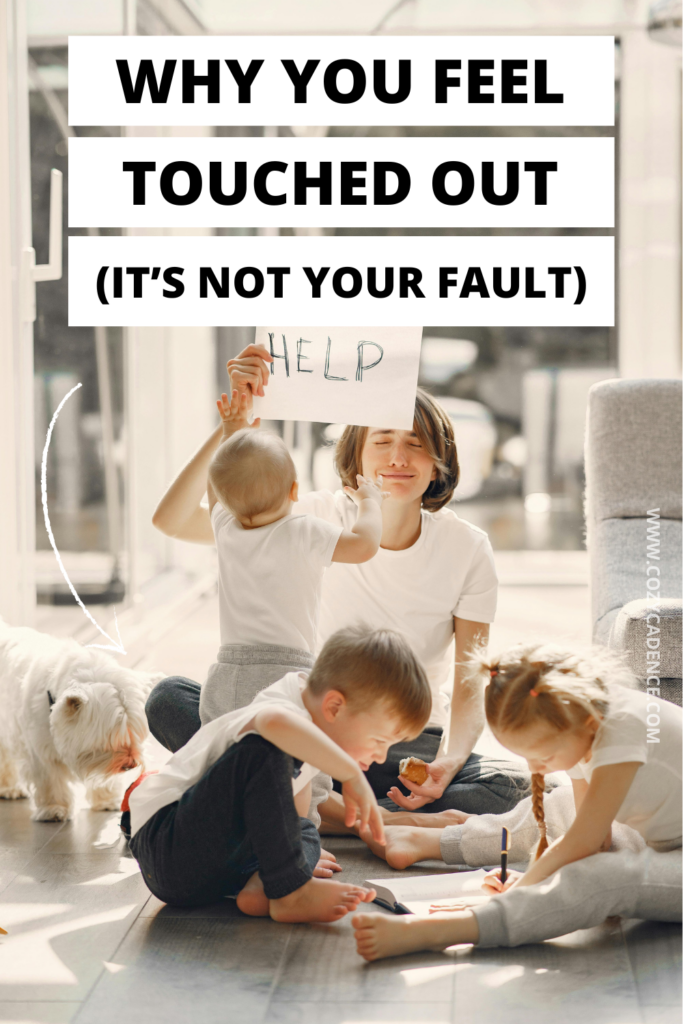
What Does “Touched Out” Actually Mean?
Because “I just need everyone to stop touching me” deserves a better explanation than “you’re probably just tired.”
Being touched out is not the same as being tired. Tired is fixed by sleep. Touched out is something else entirely.
It is what happens when your body has absorbed so much physical contact, so much grabbing, climbing, nursing, needing, pulling, that your skin stops feeling like yours. Your nervous system has been taking in sensory input all day long with no real break, and at some point it just… stops coping. The tank hits zero. And suddenly even a gentle hand on your shoulder from someone you love feels like too much. 😅
The physical sensations are hard to describe if you have never felt them, but if you have, you will recognise every single one of these instantly.
- Your skin feels hypersensitive, like everything landing on it is slightly too loud
- You flinch at unexpected touch, even soft touch, even from your own child or partner
- You go stiff instead of relaxing into a hug
- You feel a wave of irritation, sometimes even anger, when someone touches you and you cannot fully explain why
That last one is the one that trips most moms up. Because the irritation feels like it means something about how you feel about your kids. It does not. Touch overload and love are two completely separate things. Your nervous system is not measuring how much you care. It is measuring how much input it has processed today. That is it.
It is most common in the baby and toddler years, when physical demand is constant and relentless. But it can show up at any stage. A blended family, a needy season, a long stretch of not enough sleep. Any of it can push you over the threshold.
This is sensory overload. It is real, it is measurable, and it is not your fault. 💛
If you are not sure whether what you are feeling is touched out or just plain exhausted, here is how to tell the difference.
The Science Behind the Touched Out Feeling (Your Nervous System Is Not the Villain)
What is actually happening in your body when you hit that wall.
Your nervous system processes every single touch input that lands on your body. Every hand on your arm. Every small child on your lap. Every tug on your sleeve. Every “mum, mum, mum” that comes with a physical grab attached. It processes all of it, all day long, and it has a threshold. When that threshold gets crossed, it does not politely ask for a break. It sounds the alarm. 😅
That alarm IS the touched out feeling.
Here is where oxytocin comes in, because this part surprises a lot of people. Oxytocin is often called the “bonding hormone.” Physical closeness releases it, and in normal doses it promotes warmth, connection, and calm. Beautiful in theory. But when your body is being touched, grabbed, nursed, and needed constantly from the moment you wake up, the demand on that system becomes relentless. Research shows that chronic psychosocial stress can dysregulate the oxytocin system entirely, which means the very hormone designed to make closeness feel good starts misfiring under pressure.
At the same time, cortisol, your primary stress hormone, is quietly doing its thing in the background. Being needed constantly keeps your nervous system in a low-grade state of alert. Not full panic. Just… permanently on. Ready. Braced. And a body that never fully powers down never fully recovers either.
Why your body feels like it does not belong to you anymore goes deeper into this if you want to understand what is actually happening physically.
This is why rest alone does not fix it.
You can sleep eight hours and wake up still wound tight. Because sleep addresses tiredness. It does not address a nervous system that has been running on high alert for months. Those are two completely different problems with two completely different solutions.
None of this is a character flaw. It is biology. Your body is responding exactly the way a body responds to sustained sensory overload and chronic low-level stress. The fact that it is happening inside motherhood does not make it your fault. It makes it completely, entirely, boringly predictable. 💛

Why Moms Are More Vulnerable to Touch Overload Than Almost Anyone Else
Spoiler: it is not just the grabbing. It is everything else too.
Let’s start with the obvious part. The physical reality of motherhood is relentless in a way that is genuinely hard to explain to someone who has not lived it.
You are nursing. You are carrying. You are co-sleeping with a small person whose preferred sleeping position is directly on top of your face. You are being climbed on before you have had a single sip of coffee, patted on the arm mid-sentence, used as a piece of furniture by a toddler who has decided your lap is the only acceptable place to exist. By 9am your body has already absorbed more physical contact than most adults experience in a week. And the day has barely started. 😅
But here is the part nobody talks about enough.
The physical touch is only half of it.
Your nervous system does not just process what lands on your skin. It processes emotional demand too. The mental load, the invisible labour, the constant low-level hum of being responsible for everyone and everything, all of that keeps your nervous system activated even in the moments when nobody is literally touching you. You are “on” all the time. Tracking, anticipating, managing. And a nervous system that never fully powers down has a much lower threshold for sensory input when the touch does arrive.
This is why the blended family or large family dynamic hits so hard. More bodies means more physical demand, more emotional need, more margin required, and usually less margin available. I have five kids between us. A dog. A cat. There were seasons where I genuinely could not give my own children the hugs they needed because I was so completely depleted there was simply nothing left. That is not a parenting failure. That is a full nervous system with nowhere left to go.
And then there is the partner dynamic. Which is its own specific kind of painful.
When you are touched out, a hand on your shoulder from your partner, something that would normally feel like connection, starts to register as one more demand. One more thing your body has to receive and respond to. It is not about love. It is not about attraction. It is about a nervous system that has hit its absolute limit and genuinely cannot tell the difference between a toddler grabbing your arm and a loving touch from someone you chose. Everything just feels like more. 🫠
Sleep deprivation makes every single bit of this worse. Research consistently shows that even partial sleep loss significantly lowers sensory tolerance, meaning your threshold for touch overload drops substantially when you are running on broken sleep. Which, in the newborn and toddler years, is basically always.
This is why those early years are the peak of touched out experiences for most moms. It is not a coincidence. It is the perfect storm of maximum physical demand, minimum sleep, high emotional labour, and a nervous system that has had no real opportunity to recover. Ever.
You were never going to sail through that untouched. Nobody does. 💛
The Signs You Are Touched Out (Even If You Haven’t Named It Yet)
Some of these are going to feel uncomfortably familiar.
Most moms do not walk around thinking “I am experiencing touch overload and nervous system dysregulation.” They just think something is wrong with them. They think they are too impatient, too irritable, too cold, not present enough. They think they need to try harder to be more affectionate and then feel terrible when they cannot seem to do it.
So let’s just name it. Clearly. Out loud.
These are the signs you are touched out.
- You flinch when someone touches you unexpectedly. Not a dramatic flinch. Just a small, involuntary tightening. Your body bracing before your brain has even caught up with what happened.
- You feel genuine, profound relief when everyone is finally in bed. Not just tiredness-relief. Something deeper. The specific exhale of a body that has been waiting all day for nobody to need anything from it.
- You are avoiding physical contact with your partner. Not because anything is wrong between you. Not because you have lost interest or stopped caring. Simply because your body has nothing left and one more touch, even a loving one, feels like a request you cannot fulfill right now.
- You get snappy in the hour before bed. The kids want one more hug, one more cuddle, one more “lie with me for a bit” and something in you goes tight and sharp in a way you immediately feel guilty about. That tightness is your nervous system. Not your heart.
- You go stiff instead of soft in a cuddle. You want to melt into it. You remember melting into it. But your body just… does not. It stays braced, waiting for it to be over, and then you feel like a monster for that. You are not a monster. You are depleted. 🫠
- You have hidden in the bathroom. Door locked. Sitting on the edge of the bath or just standing there in the quiet for sixty seconds pretending you are doing something important in there. We see you. We have all been there. It counts as survival. 😅
- You feel guilty about every single one of the above and then you feel exhausted by the guilt. Which costs you even more energy. Which makes the touched out feeling worse. Which makes you feel guiltier. It is a loop and it is absolutely brutal.
I remember sitting at the dinner table one evening, completely ordinary night, nothing dramatic happening. My ex-husband came up behind me and put his hand on my shoulder. I pulled away before I even knew I was doing it. We both froze. He looked at me. I looked at him. Neither of us said anything for a second because we were both just… shocked. This was the person I chose. The person I loved. And my body had just flinched away from him like a reflex I had no control over. That was the moment I knew something was genuinely wrong. Not with us. Not with him. With how empty I actually was. I had nothing left. Not even for him. 😔
Here is what I want you to hear.
Recognising yourself in this list is not a confession. It is not proof that you are failing at motherhood or that you love your children less than other moms love theirs. It is just information. It is your body telling you something true about where it is right now.
You cannot fix what you cannot name. So. Now you have a name for it.
If your nervous system is this depleted, the 2 Minute Body Reset is exactly what it sounds like. A short, practical reset you can do in the kitchen, in the car, in the bathroom with the door locked. Free. Takes two minutes. Actually works.

What NOT to Do When You’re Touched Out (The Advice That Makes It Worse)
“Just take a bath” is not going to cut it. Let’s be honest about that.
If you have ever Googled “mom burnout” or “feeling touched out” you already know what comes up. Self-care listicles. Bubble baths. Candles. Gratitude journals. “Have you tried going for a walk?” And look, a walk is lovely. A candle is lovely. I am not here to argue with candles. 😅
But when your nervous system is genuinely overloaded, surface-level self-care is like putting a plaster on a broken bone. It is not that it does nothing. It is that it does not reach the actual problem. And when it does not work, you end up feeling worse, because now you tried the bath AND it did not fix anything, which must mean something is really wrong with you.
Nothing is wrong with you. The advice was just wrong.
Here is what actually makes it worse.
Pushing through it. Motherhood has a deep cultural script that says a good mother does not have limits. She keeps going. She digs deeper. She pushes through. And so when the touched out feeling hits, many moms just clench their jaw and keep offering their body anyway, keep receiving the contact, keep going. Which tells the nervous system that its signals are being ignored. Which makes it louder. Which makes the overload worse. Pushing through is not strength here. It is accelerant.
Forcing more physical affection. This one feels counterintuitive but it matters. When you force yourself to be more physically present than your nervous system can handle, you are not building connection. You are building an association in your body between closeness and distress. Over time, that makes the touched out response faster and more intense, not slower. Your body learns that touch equals overwhelm. That is the opposite of what you want.
Drowning in the guilt spiral. Shame about being touched out is not just emotionally painful. It is physiologically costly. Shame activates the stress response. Cortisol goes up. Your nervous system, which was already overloaded, gets an additional hit of stress hormones on top of everything else. The guilt does not motivate you to do better. It just makes your threshold lower and your recovery slower. 🫠
Waiting for a big block of time to recover. “I just need a whole weekend to myself.” Maybe. But that weekend is probably not coming anytime soon, and waiting for it means doing nothing in the meantime while the overload keeps building. What your nervous system actually needs is not one enormous reset. It is small, consistent moments of genuine regulation woven into real life.
Not a spa day.
Not a gratitude journal.
Not more pushing through.
Something that actually works in the two minutes between one person needing you and the next person needing you. That is what we are talking about in the next section.
That is exactly what the 2 Minute Body Reset is. Two minutes. Real life. No yoga mat required.
What Actually Helps When You’re Touched Out
Real things. Not the “have you tried a hot bath” things.
The goal here is not to become a different person or to overhaul your life. The goal is to give your nervous system enough genuine relief, often enough, that it stops running on empty and starts recovering. Those are two very different things and the second one is actually doable in real mom life. 💛
The difference between resting and resetting.
Resting is passive. You stop doing things and wait to feel better. Resetting is active. You do something specific that signals to your nervous system that the threat has passed and it is safe to stand down. Rest is valuable but it does not complete the stress cycle. Your body needs help crossing the finish line. That is what regulation techniques do.
Body-based resets that actually work in two minutes or less.
These are not exercises from a wellness programme designed for someone with a yoga mat and an hour of free time. They are tools that work in the kitchen, in the car, in the bathroom with the door locked.
- The shake. Literally shake your hands, your arms, your whole body if you can manage it. Animals do this instinctively after a threat passes. It physically discharges stored tension from the nervous system. It looks ridiculous. It works.
- The long exhale. A slow exhale, longer than your inhale, activates the parasympathetic nervous system. The part responsible for calm. In through the nose for four counts, out through the mouth for eight. Do it three times. That is it.
- Pushing into something solid. Press your palms flat against a wall and push. Hard. For ten seconds. This gives your nervous system something to do with the activation energy that has been building up in your body all day.
- The shoulder drop. Breathe in, pull your shoulders up to your ears, hold for five seconds, then release completely on the exhale. Most moms are carrying so much tension in their shoulders they have forgotten what down actually feels like.
If you want all of this in one place, the 2 Minute Body Reset walks you through a complete nervous system reset in under two minutes. I use it. It genuinely helps on the hard afternoons.
Creating physical space without guilt or explanation.
You do not owe anyone a detailed explanation for needing physical space. “I need five minutes” is a complete sentence. Closing a door is allowed. Asking your partner to take over so you can stand in the kitchen alone for a bit is a legitimate request, not a failure. Naming it out loud, even just saying “I am touched out right now, I need a few minutes,” takes the charge out of it and stops the shame spiral before it starts.
Why small and consistent beats big and occasional.
One self-care Sunday cannot undo six weeks of nervous system overload. But five genuine two-minute resets woven through your actual day can start to shift your baseline over time. Consistency is the whole thing here. Not intensity. Not duration. Just regularity. Small signals to your nervous system, again and again, that it is allowed to come down. 🫠
The emotional load piece.
This one is slower but it matters enormously. Touch sensitivity does not live only in the body. It lives in the invisible load too. The more mental and emotional weight you are carrying, the lower your threshold for physical input becomes. Which means reducing what you are carrying, even a little, directly affects how touched out you feel. Getting your partner to take on more. Letting things go that are not actually yours to hold. Putting some of the mental weight down somewhere. These are not just nice ideas. They are nervous system regulation by another name.
One hour a week sounds impossibly small. It is also genuinely where the recovery starts.
You do not have to stop being present and loving to start feeling like your body belongs to you again.
You just have to start giving your nervous system somewhere to land.

How to Talk to Your Partner About Being Touched Out
This conversation does not have to go the way you think it will.
Most moms put this conversation off for a long time. Because they already know how it is going to go. Their partner is going to take it personally. There is going to be a silence, or a defensive comment, or that particular hurt look that immediately makes you feel like the villain in a story where you were just trying to explain that you are exhausted. 🫠
And so you say nothing. And the resentment quietly builds. And the touched out feeling gets worse because now you are also carrying the weight of an unsaid thing.
So let’s talk about how to actually have this conversation.
The framing is everything.
“I don’t want you to touch me” lands as rejection. Full stop. Your partner hears: I don’t want you. And from there the conversation goes sideways before it has even properly started.
“I have hit my sensory limit and I need to recover” lands completely differently. It is not about them. It is about your nervous system. It is biology, not rejection, and when you frame it that way you give your partner something to actually understand instead of something to feel wounded by.
The specific language matters more than you might think. Here are some things that tend to open the conversation rather than shut it down.
- “I am touched out right now, which means my nervous system is genuinely overloaded. It is not about you. It is about how much physical input my body has absorbed today.”
- “I need twenty minutes where nobody touches me. After that I will feel completely different. Right now I just need my body to be mine for a bit.”
- “Can you take the kids for half an hour? Not because anything is wrong. Just because I need to come back down and I cannot do that while I am still being needed.”
What to do when they get defensive anyway.
Sometimes they will. Even with the best framing. And when that happens, the most useful thing you can do is stay calm and stay specific. Not “you never give me space” but “right now, tonight, I need an hour.” Not “you always want something from me” but “I am running on empty and I need to refill before I have anything to give.” Keep it about the present moment. Keep it about what you need, not what they are doing wrong. 😅
Ask for practical help as part of the solution.
This is the part most people miss. Being touched out is not only a sensory problem. It is a capacity problem. And capacity goes up when the invisible load goes down. Which means the most loving thing your partner can do when you are touched out is not just give you space in the moment. It is take something off your plate permanently.
Not just tonight. Not just when you ask. Actually take it.
The bin notifications. The school admin. The mental tracking of who needs what and when. Every piece of that they carry instead of you is directly reducing the nervous system load that makes you touched out in the first place. That connection is real. Make it part of the conversation.
This is a household problem, not a you problem.
The touched out feeling does not develop in a vacuum. It develops in a household where one person is absorbing the majority of the physical and emotional demand with not enough coming back in. That is a system problem. And system problems need system solutions, not just one person trying harder to cope.
Your partner is not the enemy here. But they are part of the solution. And they cannot be part of the solution if they do not know what the actual problem is.
Touched Out and the Invisible Load: Why They Always Show Up Together
They are not two separate problems. They are the same problem wearing different clothes.
There is a reason the moms who feel the most touched out are almost always the same moms carrying the most invisible weight. It is not a coincidence. It is not bad luck. It is cause and effect, and once you see it you cannot unsee it. 💛
Here is what is actually happening.
Your nervous system does not clock off between physical touch moments. It is running continuously, processing everything that is being asked of it. And emotional labour, the tracking, the anticipating, the managing of everyone’s moods and needs and schedules, costs your nervous system in exactly the same way that physical touch does. It is all input. It is all load. It all draws from the same depleting resource.
So by the time the first small hand grabs your arm at 7am, your nervous system is not starting from zero. It is starting from wherever it ended yesterday, which was probably already low, because the mental load does not stop when the kids go to bed. You lie there running through tomorrow. Tracking what needs to happen. Holding the invisible infrastructure of the entire household in your head while everyone else sleeps.
You were already overloaded before anyone touched you.
The touch just made it visible.
This is why moms who are carrying the most invisible weight hit their touch threshold fastest. It is not that they are more sensitive or less resilient. It is that their baseline is lower before the day has even started. The mom who is genuinely sharing the mental and emotional load with a partner has more nervous system capacity available when the physical demand arrives. The mom carrying most of it alone does not. That gap is not a character difference. It is just maths. 🫠
Being the emotional backbone of a family is its own specific kind of exhausting too. Always being the one who notices when someone is struggling. The one who manages the atmosphere of the whole house. The one who absorbs everyone else’s big feelings and helps process them. That is not a small thing. That is a full-time nervous system job on top of everything else. And it leaves very little margin for anything, including being touched.
This is why quick fixes only ever give temporary relief.
A body-based reset helps in the moment. A long exhale, a shake, some physical space. Genuinely useful. But if you go back to carrying the same invisible load five minutes later, you will hit your threshold again just as fast tomorrow. The reset bought you time. It did not change the underlying conditions.
Real, lasting relief from touch overload requires both things. The immediate regulation AND the longer work of reducing what you are carrying invisibly. Not perfectly. Not all at once. But consistently, honestly, and with your partner actually involved in the solution rather than accidentally being part of the problem.
The cumulative cost of carrying both together, the physical demand and the invisible load, is the kind of exhaustion that has no clean explanation and no simple fix. It is the exhaustion that makes you snap over nothing and lie awake despite being bone tired and cry in the shower for reasons you cannot quite name.
It is not nothing.
It is everything. Stacked up quietly over a very long time.
And it deserves more than a bubble bath.
This post on the invisible load of motherhood is worth reading if that part landed.

You Are Not Too Much. You Are Just Running on Empty.
If you made it to the end of this, something in here probably landed. Maybe more than one thing. Maybe you are sitting with that specific feeling of finally having a name for something you have been quietly carrying for a long time. 🌙
That name is not “bad mom.”
It is not “too sensitive” or “not cut out for this” or “needs to try harder.”
It is touched out. It is a real, measurable, completely explainable response from a nervous system that has been giving everything to everyone with not nearly enough coming back in. That is it. That is the whole diagnosis.
Your body is not broken. It is just full.
And full is fixable. Not overnight. Not with one good weekend or a candle or a gratitude list. But with small, consistent, honest steps that actually address what is happening instead of papering over it.
You are allowed to feel like your body belongs to you again. Not in some future version of your life when the kids are older and the load is lighter and everything somehow gets easier. Now. In your actual life. On an actual Tuesday with the dishes still in the sink and someone probably calling your name from the other room as you read this. 😅
Start where you are.
That has always been the only place worth starting. 💛
If you want to start with something quick and practical, this is where I would go first. 💛